


© DEVB

.png?language=en "Anthony-So-portrait (1)")

Tony Ho, Anthony So and Edmond Liu, the Development Bureau (DEVB) of the Government of the Hong Kong Special Administrative Region of the People’s Republic of China
Through two pioneering initiatives – SmartEye, the first-of-its-kind digital co-supervision platform for remote supervision, and CPECS, an integrated Contract Payment e-Check System – Hong Kong is demonstrating how advanced technologies can significantly enhance contract administration of NEC contracts, as well as site supervision efficiency and effectiveness.
Hong Kong stands as a leading international infrastructure centre, globally recognised for its exceptional infrastructure developments, which feature iconic skyscrapers, complex underground systems, and spectacular bridges and tunnels, along with comprehensive infrastructures for slopes, water supplies, sewerage and flood control and more. The city is at the forefront of technological advancements that enhance project delivery performance and showcase how innovative solutions can drive success in the infrastructure sector, whilst safeguarding high quality.
The Development Bureau (DEVB) of the Government of the Hong Kong Special Administrative Region (HKSAR) of the People’s Republic of China is championing the advancement of innovative digital solutions and remote sensing technologies for broader applications in construction projects. At the same time, digital means are being developed to facilitate NEC contract management that fosters collaboration and efficiency through a steadfast commitment to NEC principles.
Through two groundbreaking initiatives – SmartEye, the first-of-its-kind digital co-supervision platform for remote supervision, and an integrated Contract Payment e-Check System (CPECS) – Hong Kong is demonstrating how advanced technologies can significantly enhance the site supervision efficiency and effectiveness as well as contract administration of NEC contracts. These initiatives not only address practical challenges but also redefine the practices of construction supervision and contract administration.
Through two groundbreaking initiatives – SmartEye, the first-of-its-kind digital co-supervision platform for remote supervision, and an integrated Contract Payment e-Check System (CPECS) – Hong Kong is demonstrating how advanced technologies can significantly enhance the site supervision efficiency and effectiveness as well as contract administration of NEC contracts.
SmartEye: transforming site supervision with actionable intelligence
Upon thorough review, it was found that common digital solutions for construction site supervision rely heavily on Internet Protocol (IP) cameras and Internet of Things (IoT) sensors. However, these solutions do not provide the spatial information necessary for dimensional and positional checks, thereby restricting the applicability of the solutions.
In light of this, DEVB has developed SmartEye in-house, a patented new solution with digital co-supervision platform for smart construction management, which incorporates the latest technologies, including four-dimensional Light Detection and Ranging (4D LiDAR), 5G Fusion Bonding, Generative Artificial Intelligence (AI) and Large Language Model (LLM). SmartEye is a tailor-made intelligent solution for real-time, round-the-clock, all-weather remote supervision of a broad range of construction projects. By leveraging 4D LiDAR and Generative AI, it powers an innovative ‘Video of Point Cloud’ capability, enabling off-site checks of workmanship and monitoring of construction productivity through a centralized digital platform accessible via desktop or mobile devices (e.g. iPads or iPhones). The system therefore facilitates timely reporting and alerts on site progress, changes and performance issues.
SmartEye is designed to be used jointly by clients, consultants and contractors, which not only embodies the NEC principles of mutual trust and co-operation, but also allows transparent co-supervision of construction projects. It effectively facilitates ‘early detection, early follow-up and early resolution’ of on-site issues. By transforming data into actionable intelligence, it enables site supervisors to identify and prioritise areas for detailed site inspection, thereby empowering them to make timely and informed decisions for precise surveillance. It streamlines daily workflows and practices, which significantly enhance site supervision efficiency, effectiveness and flexibility. Overall, SmartEye elevates the standards of NEC contract management by strengthening early warnings, collaborative problem-solving and effective programme management — essential elements for successful project delivery.
SmartEye is designed to be used jointly by clients, consultants and contractors, which not only embodies the NEC principles of mutual trust and co-operation, but also allows transparent co-supervision of construction projects
Key features
SmartEye encompasses the following four groundbreaking technologies:
4D LiDAR - a novel technology combining the advantages of video (time-series imaging) and LiDAR-generated point cloud data. It provides dimensional and positioning information, offering a reasonable level of accuracy for common site usage. The ‘Video of Point Cloud’ can be produced using fixed-point approach by mounting LiDAR devices on fixed poles, tower cranes or non-movable objects, or via fixed-route approach utilising small, unmanned aircrafts or robots, designed to minimise blind spots and provide continuous spatial data and allow all-weather surveillance of construction activities.
Edge computing – adopted to optimise the size of point cloud images from various locations and enhance them with colour and geo-referencing features. It also provides zero-lux vision, enabling real-time, round-the-clock site monitoring.
5G fusion bonding – a technique combining data bandwidth from multiple mobile operators to create a large data channel for transmission that can increase uplink data bandwidth up to three times.
Generative AI and Large Language Model (LLM) – deployed to transform site data into actionable intelligence, operated by an AI-driven Interactive Dashboard equipped with versatile functions including a ‘4D Point Cloud Video’ viewer for assessing built quality and performing site measurements, instant safety alerts, a network of real-time AI cameras for construction monitoring, automated site report generation and AI chatbot.
 SmartEye's novel technologies
© DEVB
Real-world applications and outcomes
Since its launch in late 2024, SmartEye has been adopted in eleven construction projects in Hong Kong, encompassing various civil, geotechnical and building works, such as site formation, deep excavation, building, sewage treatment works, and waterworks. All the projects have demonstrated promising results. With the availability of spatial information, many analyses that were previously challenging to perform are now much more feasible. These include measuring the profile changes of slope cutting or filling works over time, assessing volume of excavation materials, monitoring site progress, checking configuration of excavation and lateral support works and identifying unsafe acts, unauthorized activities and defective works. This capability directly supports the NEC requirement for project managers to evaluate whether the works are being implemented according to accepted programmes and whether contractor's plans are practicable.
Positive feedback from industry stakeholders reflects not only technological advancement but also practical improvements in contract administration efficiency. From April 2026 onwards, the Hong Kong Government will mandate the adoption of the SmartEye for large public works construction projects, aiming to enhance supervision efficiency and effectiveness to ensure the quality of work is upheld.
From April 2026 onwards, the Hong Kong Government will mandate the adoption of the SmartEye for large public works construction projects
International recognition
SmartEye received the Best International Invention & Innovation Award from the National Research Council of Thailand at the 50th International Exhibition of Inventions of Geneva in April 2025, which demonstrates that Hong Kong's innovations are advancing global construction practices. This technology is generating keen interest from local and overseas industry stakeholders, suggesting potential for wider adoption beyond Hong Kong.

Edmond Liu, Chief Assistant Secretary (Works) of the DEVB, introducing the award-winning SmartEye
© DEVB
CPECS: streamlining NEC payment processes
CPECS aims to address the resource-intensive aspects of managing NEC target contracts by enhancing the processes for contract payment applications and verification through digital means.
Under NEC target contracts, contractors are required to provide project managers with complete visibility of actual costs, including records, invoices, timesheets, accounts and subcontract payments to substantiate each payment application. However, this requirement necessitates that project managers verify a substantial volume of supporting documentation before certifying each payment, resulting in increased resource demands for document checks.
In Hong Kong’s public works projects, several project teams have successfully introduced CPECS for improving efficiency in managing contract payment applications under NEC target contracts. Project teams — comprising client, consultants and contractors — have collaborated to tailor this AI-powered system to suit specific workflows for payment processing, including classification of documents, identification of anomalies, extraction of cost data and verification of payment amount. Due to a lack of pre-trained AI models for invoice data analysis, a structured learning framework was implemented using a curated dataset comprising hundreds of samples to enhance the data extraction accuracy. By automating these routine tasks, it augments project managers’ capabilities, allowing them to focus on higher‑value and risk‑critical areas.
In Hong Kong’s public works projects, several project teams have successfully introduced CPECS for improving efficiency in managing contract payment applications under NEC target contracts.
Generating intelligence from cost data
Beyond enhancing efficiency in individual payment cycles, the use of CPECS for individual contracts generates valuable cost intelligence from the large volumes of processed data. This can support the evaluation of compensation events in ongoing contract by drawing on historical cost data from similar activities as a basis for assessment. Starting in April 2026, all NEC target contracts for public works in Hong Kong will adopt CPECS to broaden its applications. Actual cost data from completed target contracts will provide realistic benchmarks for versatile uses. To maximize this benefit, DEVB plans to establish a centralized cost database to consolidate extensive contract data. This database will enhance the effectiveness of cost data across various applications, including cost estimates for new projects, updating of cost indices and unit rates, contract administration and the assessment of compensation events.
Starting in April 2026, all NEC target contracts for public works in Hong Kong will adopt CPECS to broaden its applications.
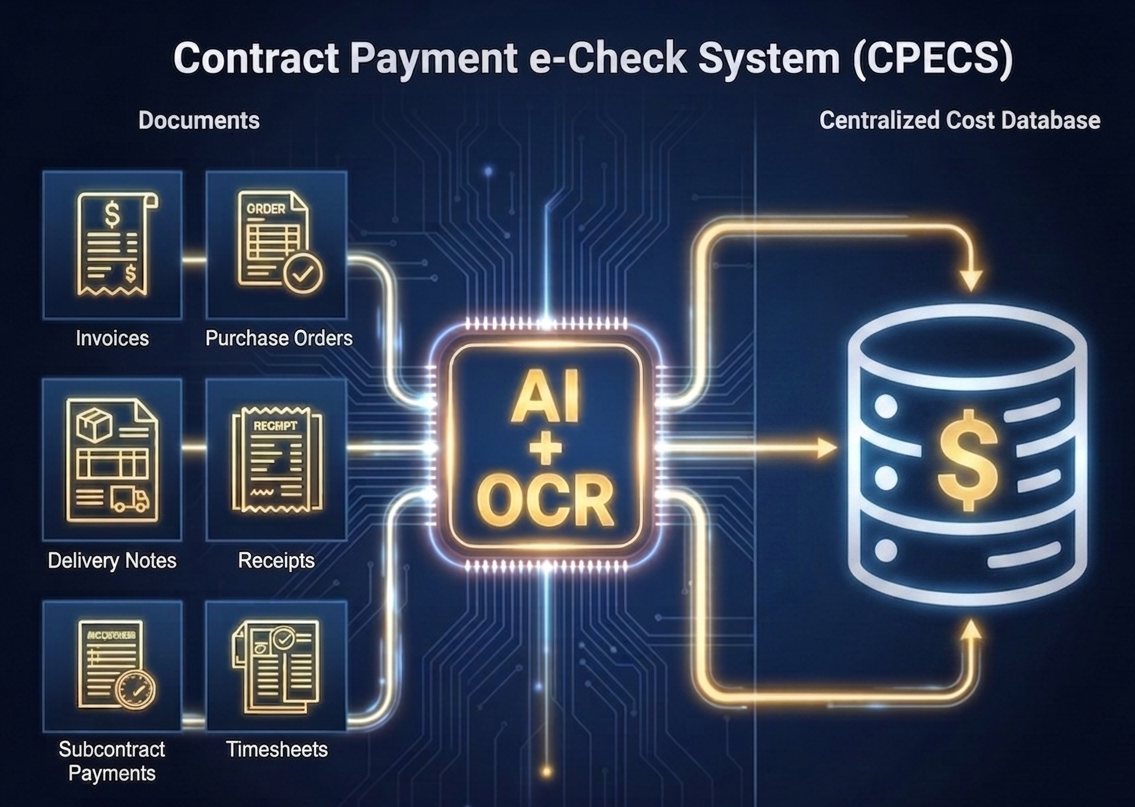
Contract Payment e-Check System (CPECS)
© DEVB
Conclusion
NEC contracts provide effective mechanisms for the successful delivery of projects through collaboration built on mutual trust and co-operation. While traditional supervision and administrative methods are well established, DEVB has been actively driving enhancements to elevate project performance in response to today's increasingly complex construction environment.
The two novel systems, SmartEye and CPECS, illustrate how advanced technologies can enhance NEC contract management. SmartEye revolutionizes transparent co-supervision with its innovative ‘Video of Point Cloud’ and AI capabilities, providing real time site information that is simultaneously accessible to clients, consultants and contractors. CPECS enables payment verification in NEC target contracts by harnessing AI to streamline the process while generating valuable cost intelligence.
The two novel systems, SmartEye and CPECS, illustrate how advanced technologies can enhance NEC contract management.
By embracing these smart solutions that support early warning, accurate programme management, efficient payment processing and evidence-based compensation event assessment, these systems help realise the full value of NEC contracts.
As construction projects worldwide face similar challenges, such as complexity, quality expectations and resource constraints, Hong Kong's experience provides valuable insights. The next frontier of NEC excellence lies in the seamless integration of its framework with purpose-built digital co-supervision platforms that foster collaboration, transparency and compliance.
- Author
- Tony Ho, Anthony So and Edmond Liu
- Share this page
-


- Copy link



-Paul-Carstairs.jpg?width=1200)