



Andrew Wooldridge-Irving
Key points:
- Communications are a fundamental part of all NEC4 contracts.
- A notification is an important type of communication that must be communicated separately.
- NEC users should be aware of the significance of notifications that act as a condition precedent.
Although ‘communication’ is not an NEC defined term, an NEC communication could be described as the transfer of written information to start or give effect to a contract requirement, process or procedure.
There are different types of communication within NEC4 contracts, each serving a particular purpose. The contracts describe the type of communication required to be given, which include the following: instruction, submission, proposal, certificate, acceptance, information and notification.
NEC4 contracts specifically require a notification, or notice, to be used where important information is to be brought to the attention of a recipient. For all long-form NEC4 contracts, Clause 13.7 require notifications to be communicated separately from other communications. The NEC User Guides state that the reason for this is ‘to avoid important things being overlooked’.
Notifications serve several purposes under the NEC4 contracts, each of which is considered below.
Information
The notification of information can require no further action, with the notification formally confirming the outcome of a decision or action. It can include the following: a task will not be instructed; purchaser assessment of a compensation event quotation; assessed changes to the budget for an early contractor involvement; an agreed extension to the service period; a change of control has occurred; and the name of an identified third-party beneficiary.
Information requiring further action
The information provided within a notification can require further action to be taken, either in the form of a response or a change to a procedural requirement. Examples include: address for receiving communications; an ambiguity or inconsistency; offsite plant and materials have passed a test or inspection; further records are needed to assess a finalisation of defined cost submission; correction to a compensation event assumption; proceed to stage two of an early contractor or alliance involvement; and amount assessed as due at the end of an accounting period.
Facilitate a procedure
A notification can be used to start several important procedures under NEC4 contracts. These include: early warnings; defects; finalisation of defined cost; compensation events; termination; and resolving disputes. Note that a notification given under the early warning procedure relates to a matter that could cause one of the stated effects to occur.
Condition precedent
A condition-precedent notification is where a requirement in a contract is to be fulfilled before either a corresponding right follows, or a stated action may be taken. Within NEC4 contracts there are numerous such condition precedents connected to the giving of a notification, including the following: delegating actions; replacing a named role; reminder of a failure to respond to a programme or plan submitted for acceptance; reminder of a failure within the compensation event procedure; termination right for specified defaults; and referral to dispute resolution.
As an example, under the NEC4 Engineering and Construction Contract (ECC), either party may notify of their intention to end the contractor’s obligation to provide the works, giving details. The project manager’s next action to issue a termination certificate is dependent upon the required notification being given.
Some condition-precedent clauses require a notification to be given within a stated period, further providing that if the stated timescale is not followed, then certain specified rights are lost. This type of condition-precedent clause is commonly referred to as a ‘time bar’. NEC4 contracts include time-bar provisions as detailed below.
Compensation event notification time bar
Clause 61.3 says the supplier must notify certain compensation events within a specified period. This starts when the supplier becomes aware that the corresponding event has happened. The relevant supplier and corresponding period are detailed in Table 1 below.
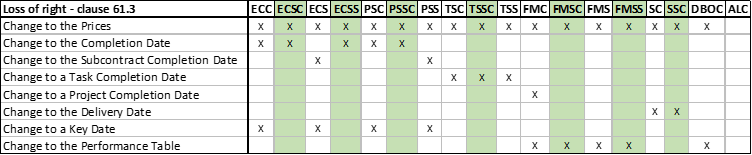
Non-compliance with the time-bar clause results in the supplier losing the rights shown in Table 2 below. Note that an equivalent time-bar clause is not included in the NEC4 Alliance Contract (ALC).
Pay less notification time bar
Issuing a pay-less notice is a statutory right under Part II of the Housing Grants, Construction and Regeneration Act 1996 (HGCRA), as amended by Part 8 of the Local Democracy, Economic Development and Construction Act 2009. This right applies to a construction contract as defined in Section 104 of the HGCRA, with specific reference to Section 105 and the meaning of construction operations.
The statutory right provides for the payer, ie the person or party obliged to make a payment, to pay less than the notified sum. The notified sum may be determined by either a payment certificate, payment application or invoice, depending upon whether the contract procedure runs as a payer-led or payee-led process. Where the payer intends to pay less than the notified sum, a notice must be given, by either the payer or specified person, in line with Sections 111 (4) and (5) of the HGCRA.
The payment provisions under NEC4 contracts are in core Clause 5 and supplemented by further provisions where the HGCRA applies to the contract, either by the selection of Option Y(UK)2 for the long-form contracts or additional conditions for short-form contracts. This requires a notice to be given not later than seven days before the final date for payment. Where a compliant pay-less notice is not given within the period stated, then the notified sum must be paid by the final date for payment.
Notifications including other communications
Although notifications are required to be communicated separately, in certain instances a notification is required to contain other types of communication, including as follows: acceptance – programme or plan; acceptance – change to the implementation plan; acceptance – acceleration quotation; instruction – submit quotations for a compensation event; acceptance – compensation event quotation; and acceptance – climate change plan.
Conclusion
Notifications are an important part of communications within every NEC4 contract, with the contract specifically saying when a notification, or notice, must be given. Users should be aware of any amendments to the standard contract clauses, particularly notifications that are a condition precedent or relate to a time-bar provision.
Table 1. Time bars for notification of compensation event by NEC4 contract suppliers
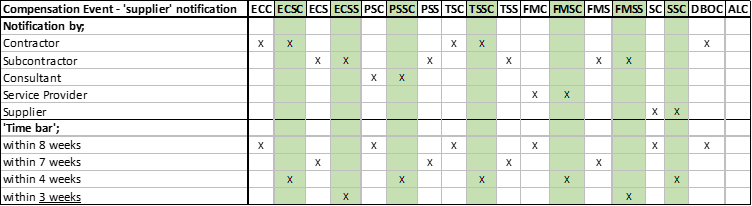
Table 2. Rights lost when supplier fails to notify compensation event within time bar
- Author
- Andrew Wooldridge-Irving, GVE Commercial Solutions
- Share this page
-


- Copy link



-Paul-Carstairs.jpg?width=1200)