



Darren Ward
Key points:
- NEC4 ECC Option C and E contracts allow the project manager to check the contractor’s records that ultimately support defined cost payments.
- This article provides guidance for the effective auditing of plant and material costs on NEC4 Option C and E contracts
The NEC4 Engineering and Construction Contract (ECC) Options C (target contract with activity schedule) and E (cost reimbursable contract) are widely adopted for high-risk infrastructure projects in the UK. Under the core clauses, project managers are entitled to inspect accounts and records relating to items of defined cost.
This article provides guidance on the audit of plant and material costs, where contractors must demonstrate that costs are allowable under the contract, have been used in the works and are supported by appropriate accounts and records. Earlier NEC Newsletter articles have considered directly employed staff costs (Ward 2024a), labour and agency costs (Ward 2024b) and equipment costs (Ward 2025).
Definitions
Under NEC contracts, plant and materials are items purchased by the contractor for incorporation into the works. The definition is distinct from equipment, which is used in construction but removed before completion. Under the NEC4 ECC cost-reimbursable options (Options C, D and E), contractors are paid at ‘open market or competitively tendered prices’ (Clause 52.1), with supporting accounts and records open to inspection (Clause 52.4).
Applications for payment are submitted monthly and supported by cost ledger reports referencing delivery notes or invoices. A common mistake is to rely on checking large numbers of invoices, even though this is sometimes mandated by clients. This article instead sets out a more pragmatic approach, providing assurance without the need to test every transaction.
Read and understand the contract
In this guidance, the focus is on the NEC4 ECC Options C, D and E, where the defined cost for plant and materials is based on the schedule of cost components. Allowable items include the purchase of goods and associated delivery or removal charges. Under Clause 11.2(26), plant and materials not used in the works (beyond reasonable wastage) are disallowed, and the contractor must show waste is minimised.
Additional Z clauses may add further requirements, though changes to the core rules are rare. Defined cost must be evidenced by accounts and records, such as purchase orders, delivery notes, invoices, proof of payment and relevant site records. Payment information is often overlooked, but is important, as it may reveal early payment discounts, contras or credit notes. It will also confirm that costs will be paid before the next assessment.
The scope may also require that additional records be provided, such as closed-circuit television, vehicle logs, barcodes, survey or lidar data. An invoice alone is not sufficient evidence; contractors must demonstrate that plant and materials have been used in the works.
Clause 52.1 requires defined cost at open market or competitively tendered prices, net of recoverable discounts, rebates and taxes. Group-level rebate agreements are often difficult to obtain. If records are withheld, the project manager may make an assessment. These rules apply equally to major reimbursable subcontract packages.
Understand the environment
The NEC promotes working in a ‘spirit of mutual trust and co-operation’, but clients must still check that contractors and subcontractors operate effective risk frameworks, internal controls and fraud deterrence. Ideally, internal controls, financial systems and payment processes should be reviewed before works begin, although in practice this is rare.
Auditors often move straight to sample testing without first understanding these controls. Yet their effectiveness is critical, as it should influence both test design and sample size. For example, costs supported by manual spreadsheets are more error-prone than those downloaded from an accounting system. The higher the expected misstatement, the larger the sample size should be.
A first step in any review is to understand and assess the contractor’s internal financial controls. This includes the following:
- What core processes for plant and materials are in place
- How third-party suppliers are identified, tendered and contracted
- How the contractor demonstrates value for money
- How spend is budgeted and controlled
- What delegated authorities apply to purchase order approval or invoice sign-off
- What checks exist in the accounting system to match invoices, reverse accruals and prevent error
- How key financial records are stored and accessed.
Auditors also need to understand what additional reports can be provided from the accounting system, such as order analysis and material delivery reports. This includes finding out if the cost ledger show invoices and payments, or only reflects goods received; how old accruals are cleared; and whether costs are likely to be paid before the next assessment date.
They then need to check that plant and material claims always reconcile to the contractor’s accounting system, which contains built-in controls to support accuracy. This should be carried out in real time to ensure the data is fresh and unaltered.
Auditors should always walk through the accruals process. Typically, costs are first booked from a delivery ticket matched to a purchase order, with the invoice matched later to the delivery note (three-way matching). At this point, the ledger should reference a supplier invoice number, indicating a match. A lack of invoice numbers may suggest aged accruals requiring follow-up.
Finally, auditors should step beyond the accounting records to understand how plant and material costs are prepared, controlled and reported at site. They should obtain background on the project, tour the site, and speak with stores and logistics staff to see how items are received and inspected. Where materials are stored off-site, marking up may be relevant under Clause 71.
Visualising data and designing tests
Good data analysis relies on a complete data set from both accounting and site records. Cost reports often contain only basic fields, but purchase order reports may provide better data sets than those routinely included in an application for payment.
Auditors should break down supplier spend to see what plant and materials are delivered or used on site. They should look for trends by cost head or date, but note this will not always highlight higher-risk items, and check for invoices not matched to goods received notes or purchase orders. Keyword searches (such as loss, damage, wastage, theft) should be used to identify non-recoverable items.
More advanced analytics can add value but may need specialist software, as tools like Excel or Power BI can be limiting. An example of effective data visualisation is shown in Figure 1. A clear understanding of the environment, supported by good data analysis, helps identify where costs may be mischarged and guides which higher-risk transactions to inspect.
Auditors must then decide how best to test and sample the wider population to reach reliable conclusions. Tests may include verification back to source documents, computational checks, confirmations with suppliers or proof in total. The latter can be valuable, comparing claimed costs to site records or design drawings.
Sample size and method need careful thought. Options include random sampling, or statistic techniques like monetary unit sampling. Whatever approach is used, samples must be selected to represent the wider population. This may involve stratifying transactions into sub-groups with similar characteristics. Determining the right sample size is both a science and an art.
Examine, evaluate and report
When reviewing accounts and records, only properly supported costs are allowable. Be pragmatic where evidence is not clear. For example, how are three-way matching processes impacted when delivery notes are lost from site. If it relates to a series of steel columns and beams going up opposite the site office, then look out of the window.
Be cautious with extrapolation. Unsupported costs may reflect anomalies rather than systemic issues, so consider stratifying samples, root cause analysis or alternative tests before drawing conclusions. Where issues emerge by transaction type, supplier or period, extend checks to the full population.
Finally, auditors should record their work, draw conclusions and report clearly, leaving a robust audit trail for others to rely on.
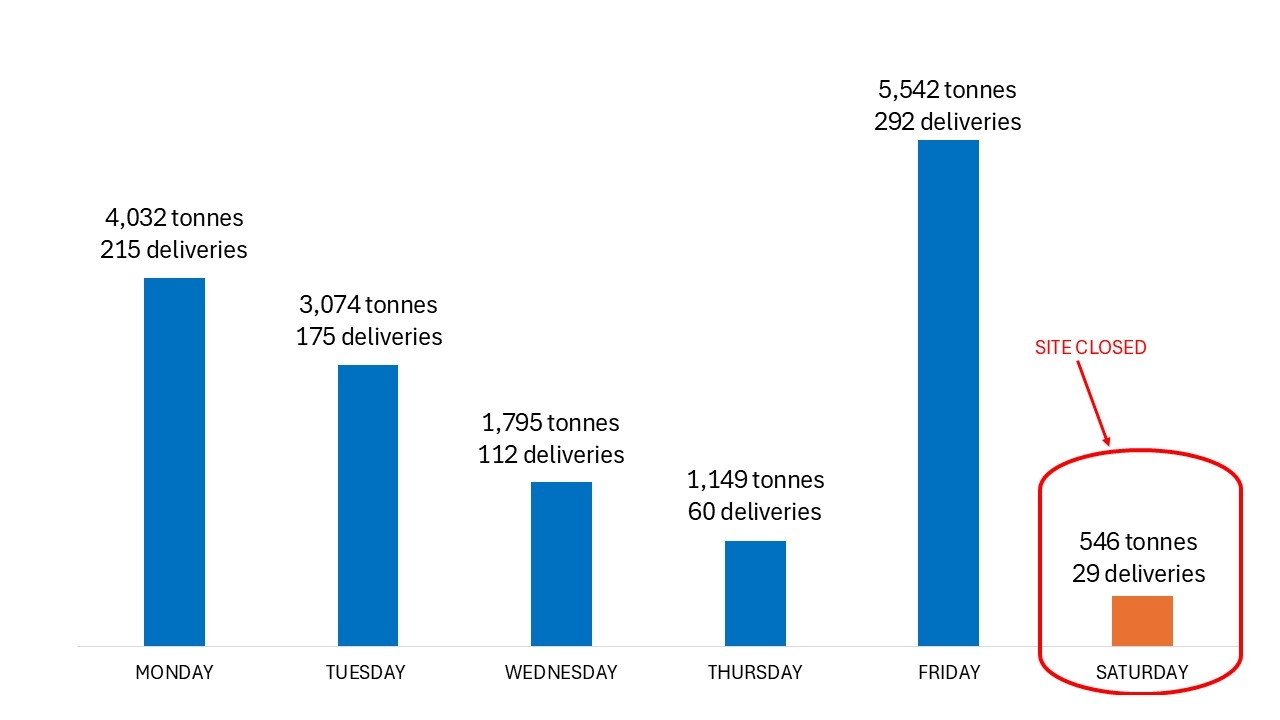
Figure 1. Analysis of delivery ticket data by weekday for type 1 materials identified weekend deliveries when the site was closed.
- Author
- Darren Ward, The Orange Partnership
- Share this page
-


- Copy link



-Paul-Carstairs.jpg?width=1200)