




NEC has become a mainstream form for UK dredging/coastal works, but it is not ‘one-Option-fits-all’. David Kinlan and Richard Patterson review how careful Option selection and Contract Data should be used for successful project outcomes.
Key Points:
- NEC has become a mainstream form for UK dredging/coastal works, but it is not ‘one-Option-fits-all’:
- Option selection tracks how much quantity / productivity / metocean uncertainty the Client is willing to carry.
- In a 9-year dataset sourced from within the dredging sector, 43.8% were NEC. Of non-NEC, 43% were vessel charters (ie rental or hire). Within NEC, Engineering and Construction Contract (ECC) Option A leads (45.3%), then ECC Option C (26.4%), then the Engineering and Construction Short Contract (ECSC) (9.4%), with smaller tails for Options B/D/E and hybrids.
- Option A (ie Lump Sum) is favoured where the work can be packaged as repeatable priceable campaigns with controllable production assumptions. The Contractor takes the risk of quantities.
- Option C (target cost) is often chosen where the Client wishes to promote (more) collaborative behaviour. The costs are effectively shared according to percentages set by the Client and the cost effect of Contractor’s risks is shared. As a result, the Client and its Project Manager have a direct commercial incentive to collaborate. An issue is that the Client will normally need to audit the Contractor’s costs.
- NEC itself describes Option C as suited to more complex/larger projects with shared financial risk.
- Option D (target cost with bill of quantities). The sharing effect is that same as in Option C but the Client takes the risk of the quantities. From a management point of view the Clients will need to audit the Contractor’s costs AND there is a need to remeasure the quantities.
- Option E (reimbursable). The Client pays the Contractor’s costs subject (as with C and D) to some costs being ‘Disallowed Cost’.
- NEC4’s standard weather compensation event mechanism ‘once in ten years’ exceedance in a calendar month at an agreed station is totally inappropriate for dredging, where lost time is driven by wind, wave, swell, currents on the operation of marine vessels.
- The Engineering and Construction Short Contract (ECSC) is shorter and simpler. It has a ‘Price List’ in which the Client can use quantities where it wants to take the quantity risk and lump sums where it does not. A comparison between the NEC4 ECC and the ECSC is here.
The NEC contract as a ‘client preference’ is close to a default option for non-hire or rental assignments across dredging & marine works in the UK and mandated where public-sector or framework procurement is in play.
But the interesting part isn’t that NEC is used. It’s which pricing Option is used, and what that implies about risk appetite and who is really carrying metocean1 volatility and quantity uncertainty.
What the numbers say
A study of a tender dataset containing 121 UK dredging/coastal/marine packages over the last nine years showed that 53 were NEC (43.8%).
Within those 53 NEC contracts, the Option selection is telling:
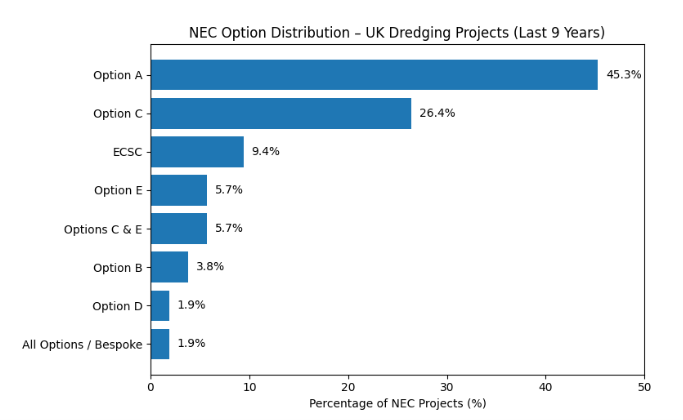
That distribution is not random. It maps onto how dredging risk is actually handled in the market when using NEC.
Why these NEC Options get chosen for dredging and coastal works in the UK
Option A: ‘We think we can define it, and we want price tension and price certainty’
Option A (priced contract with an activity schedule) dominates the use of NEC for dredging projects. That usually points to one of three commercial realities:
- Maintenance-style dredging (repeat campaigns, known volumes, known conditions);
- Client certainty bias: client legal and finance teams prefer the optics of ‘priced’ work even where a degree of uncertainty exists. They then try to manage the uncertainty operationally (tight change control, strict method constraints); or
- Procurement efficiency: Option A is easier to tender cleanly, especially for smaller harbour authorities and councils.
But in dredging, the most volatile risks - weather downtime and productivity loss need to be factored into the Contractor’s price. That works only if the Contract Data is drafted to reflect dredging reality (more on that below).
Option C: ‘We accept uncertainty, but we still want control and transparency’
Option C is the second most common option. NEC describes Option C as a target cost contract suited to complex or larger projects where the parties share financial risk collaboratively.
In dredging, Option C tends to be chosen when the Client recognises one or more of the following:
- Uncertain dredgeability: variable sediment types, possible obstructions;
- Interface risk: navigation constraints, fisheries windows, marine licences, third-party berth operations; and/or
- Programme volatility: weather windows, mobilisation uncertainty, plant availability.
But for the Contractor to set a target, it needs a clear Scope just as it does in Option A. And the contract needs clarity as to what will be a compensation event – as is the case in all options.
A good example is the Bacton to Walcott coastal management scheme (fast-paced coastal nourishment/dredging logistics), where the project team adopted NEC3 ECC Option C specifically to share risk/benefit and cope with inherent cost uncertainty.
Likewise, the Environment Agency’s marine and coastal framework campaigns have used ECC Option C, with Z-clauses and a transparent mechanism to manage marine-environment risks and cost drivers.
Option E (and C/E hybrids): ‘We can’t sensibly price it yet’
Option E (cost reimbursable) is small in the figures, but it’s strategically important.
It tends to appear where:
- The Client wants a rapid deployment;
- The risk is genuinely not priceable without further detailed data (eg, access constraints, unknown obstructions, uncertain disposal route); and
- The Client is buying capability and responsiveness, not a fixed output.
Note this is effectively using NEC Option E as a form of vessel rental. Remember of Non-NEC contracts, 43% were vessel rentals
So what’s the underlying pattern?
Put bluntly:
Option A is chosen when the Client wants the Contractor to carry all of the ‘efficiency risk’ in the price.
Option C is chosen when the Client needs flexibility without losing cost visibility particularly under frameworks and public accountability. In option C the ‘efficiency risk’ and the cost impact of Contractor’s risks (events that are not compensation events) is shared.
Option E / hybrids show up when the parties are being honest: ‘We don’t have the data yet.’
Which brings us to weather.
Because dredging is effectively a metocean-bounded production process.
NEC weather compensation events: why Contract Data Part One must be amended for dredging
NEC4 ECC’s weather compensation event is built around an apparently objective test: a ‘once in ten years’ exceedance of a specific ‘weather measurement’ identified in the Contract Data within a specific calendar month, using measurements at an agreed location, with example weather measurements typically limited to those in the standard ECC document:
- ‘the cumulative rainfall (mm)
- the number of days with rainfall more than 5 mm
- the number of days with minimum air temperature less than 0 degrees Celsius
- the number of days with snow lying at hours GMT’
This compensation event is totally irrelevant to dredging for the following reasons:
1) Other variables drive lost time offshore
Dredging downtime is often driven by other factors such as wind speed & direction, wave height/period, swell direction, currents, turbidity constraints, visibility and navigation restrictions - not temperature, rainfall and frost.
NEC’s default variables miss the most disruptive conditions, and weather stations can be too remote to reflect real site conditions.
2) The calendar-month test masks ‘short, intense’ events
Adverse sea state conditions are commonly caused by a 48–96-hour window of unsuitable conditions. NEC’s calendar-month aggregation can fail to trigger even when the event is operationally devastating. If a second weather event closely follows a first, say by only a number of days, the period between can often be lost too (even if that weather was below the threshold) whilst equipment is repositioned.
3) Dredging programmes are weather-windowed, not calendar-windowed
Dredging is scheduled around tides, bunkering, berth availability, disposal windows and environmental constraints. Measuring weather against calendar months is operationally artificial and irrelevant.
4) It interacts badly with the pricing Options
This is where Option selection comes back in:
- Under Option A, if the weather test doesn’t trigger, the Contractor’s productivity loss has to be covered by the Contractor (and it will have to price this in its tender).
- Under Option C, this is the same but the cost will still be paid as Defined Cost so both sides will lose out on the pain gain assessment.
- Under Option E, the Client may will pay the time (and compensation events may delay the required Completion Date and increase the Prices) but the Prices are just a budget and have no commercial role, But then procurement teams ask why the final outturn ‘blew out’, when in reality the Contract Data never aligned with metocean reality.
You don’t need hypotheticals.
Dorset Council’s own public update on annual dredging at West Bay and Lyme Regisstates that dredging was planned for February/March, but the team returned later to complete removal of excessive sediment in a classic case of ‘weather window vs plan’ drift.
NEC’s Bacton/Walcott case study acknowledges delivery ‘in spite of weather delays.’
What ‘fit for dredging’ looks like in Contract Data Part One
The fix is not to argue about clause numbering.
It is to draft Contract Data Part One like a dredging contract, not a building contract.
NEC4 allows additional compensation events to be stated in the Contract Data. Any changes to the standard compensation events need to be in the additional conditions of contract (the ‘Z’ clauses).
There are several practical adaptations that translate well to dredging:
- Activity-level thresholds (pre-agree and add as a compensation event what metocean conditions stop what activities).
- Use hyperlocal data not Met Office sources (on-site / near-site wave rider buoys, agreed metocean feeds and add appropriate compensation events).
- Activity-based measurement periods (measure against the scheduled activity window, not the calendar month).
- Expanded variables (wind, wave and swell height, period and direction explicitly relevant for the nominated dredging vessels).
- For dredging, we would add one more: explicit ‘weather window’ logic tied to safe vessel operation and marine licence constraints, including agreed stand-down triggers for wave height/period and wind limits specific to the dredger class and pipeline/booster configuration.
Defined Cost of dredging Equipment
The ECC’s standard method of payment in Options C, D and E states that the Schedule of Cost pays for equipment, even if hired in from the Contractor’s in-house plant hire company at ‘open market’ rates. An alternative is to ask for rates for ‘special Equipment’ in the Contract Data Part Two.
In the case of dredging the Equipment is usually owned by the Contractor or may be a separate vessel charter. It is suggested that a rate for ‘special Equipment’ should be obtained from tenderers. Clients should request separate rates for pre-defined types Equipment on ‘standby’ and ‘in use’.
For Options A and B rates for Equipment are ‘calculated by applying the percentage adjustment for listed Equipment stated in the Contract Data to the rates in the published list and by multiplying the resulting rate by the time for which the Equipment is required.’
The list often used (and included in the Contract Data Part Two by the Client) is that published by the Civil Engineering Contractor’s Association (CECA). However, this does not include specialist dredging Equipment. So the Client should insist that the tendering Contractor submit their rates for pre-defined ‘other Equipment’ in Contract Data Part Two.
Generally, it will be appropriate for rates for pre-defined types of ‘other Equipment’ to be listed in the Contract Data.
Conclusion
The NEC story for dredging in the UK is not ‘NEC versus not NEC’. It’s Option selection as a proxy for risk philosophy.
The data shows a market leaning heavily to Option A for defined, repeatable dredging packages, while retaining Option C for larger or more uncertain programmes where flexibility and transparent cost management matter.
But NEC’s standard weather compensation event framework of calendar-month, once-in-ten-year, limited variables is not fit for purpose for dredging.
If the UK wants NEC to remain the ‘collaborative’ choice for dredging projects, then clients and consultants need to appreciate that Contract Data Part One needs to include the following as additional compensation events: metocean-aware activity thresholds, hyperlocal data, wave/wind variables, and measurement aligned to work windows.
- Author
- David Kinlan and Richard Patterson
- Share this page
-


- Copy link


-Paul-Carstairs.jpg?width=1200)
